
Sensory-Friendly Wedding Rings: Comfort Tips for Autistic Couples
Updated: Aug 28, 2025
Are sensory-friendly wedding rings a myth, or magic? Here are a few ideas for autistic couples and other sensory-sensitive folks
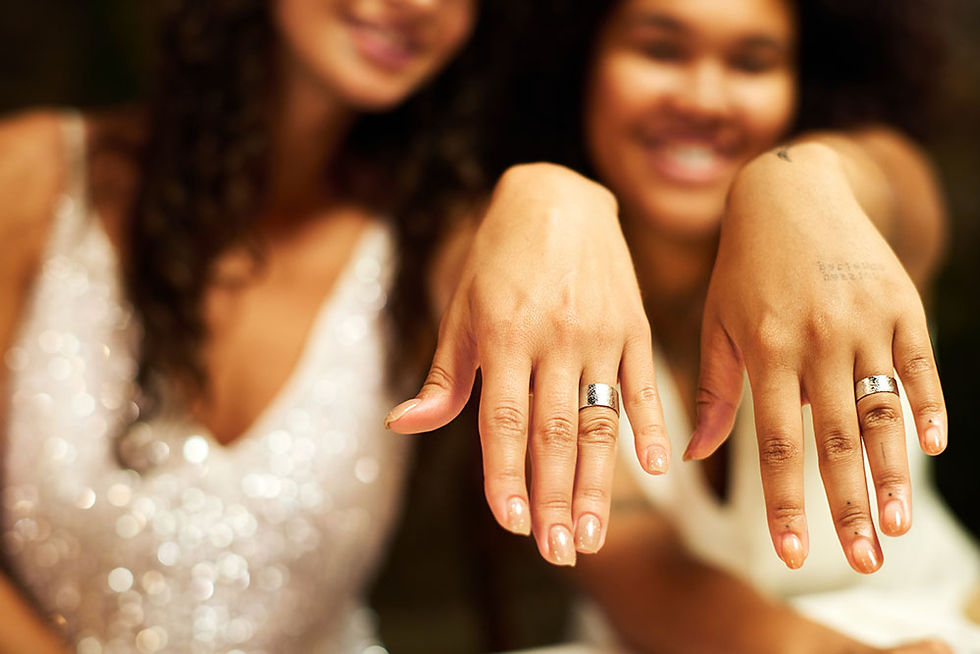
If you're a sensory-hypersensitive person like me, your daily jewelry routine consists of putting on all your favorite pieces, admiring yourself in the mirror, and then removing each one throughout the day -- or all at once in a frenzy -- as you hit your sensory limits.
And personally, rings are the hardest type of jewelry to manage. I can’t really think, type, or problem-solve with them on (all things my day-job insists I do for some reason), and so I usually find myself emptying my purse of beautiful-but-unwearable rings at the end of the day – placing them back in the ring dish, ready to start the whole process again the next morning.
But engagement rings and wedding rings are meant to be worn all the time -- not in a constant rotation at the bottom of a bag – so what are we sensory-sensitive folks meant to do?
Do sensory friendly wedding rings exist? Are they myth? Or magic? And if not, what can we do instead?

Let's take a look...
The simplest answer, of course, is to skip the wedding ring
The simplest answer, of course, is to not wear an engagement ring or wedding ring at all. I'm just putting this out there, because despite what most popular wedding blogs and jewelers would have you believe, you don’t have to have a ring to get married. Wedding rings are symbolic, not mandatory, and most of them don't have magical binding powers -- at least not right out of the store. So if you simply can't bear the thought of it, skip it! Then again, if you're like me, the idea of doing something simply out of obligation hasn't even occurred to you. So you must be here because you want to wear a ring!
With that in mind, here are a few ideas for sensory-friendly wedding rings and workarounds, plus some out-of-the-box options you may not have considered yet.
Consider a silicone wedding ring
Many autistic and sensory-sensitive folks praise silicone rings for their comfort and wearability. If you've never heard of them, here are the basics: silicone rings are made from a flexible, durable, and hypoallergenic material (called silicone). The flexible material adjusts to the shape and size of your fingers, making them more comfortable to wear if you have swelling (from arthritis or inflammation), sensory hypersensitivity or processing issues, joint instability, or hypermobility. And silicone rings look similar to metal rings, available in different colors and styles -- including metallic styles that look like traditional wedding bands!
“We wear matching silicone rings in metallic silver, they look like metal at first glance," one newlywed on a wedding forum says. "They're also a lot cheaper and safer than metal rings. I hardly feel it and forget I'm wearing it, meanwhile metal rings I fiddle with all day.”
If this sounds like something you relate to, give a silicone ring a try!

Try a wooden wedding ring
On the other hand (no pun intended), some autistic soon-to-weds and engaged sensory-sensitive folks prefer to wear wedding rings made from wood. Wood is an organic material, lightweight, and hypoallergenic for people with metal allergies -- qualities that make it a very popular and sensory-friendly option.
Personally, I especially like wooden rings with a smooth, dark, matte finish. Their soft texture, color, and lack of shine make for a pleasant, low-stimulation option. And I like that they feel natural and earthy, a bit alive and magical, almost like a comfortable friend. I can wear wooden rings almost all day, although they might still end up at the bottom of my purse if the day is particularly stressful or busy.
If you're considering wooden jewelry, however, be aware that some types of wood can become discolored over time. "I like wearing wood jewelry / rings (wood plugs in my ears even)," one autistic woman on a forum says, "but be aware that [wood is] not as durable as metal. If you wash your hands a lot and wear rings daily, the wooden rings will stain and lose color easily, even if you refinish them."
If your ring is porous or unfinished, it can absorb moisture and oils from your skin, which might darken its appearance. Still, this effect can be lessened with proper care, specific finishes, and by choosing specific woods.
And you can always retire one ring and choose a new one to celebrate a vow renewal or anniversary in a few years!
Stim-friendly wedding rings
Any ring can be a stim toy if you want it to be, but some some are made specifically for the task! If you like the sensory stimulation of finger rings, you might find long-term happiness with a spinner ring, or a tactile-rich wedding ring. Consider a wedding ring with raised edges or embellishments that feel good under the finger tips, but are subtle enough for frequent fidgeting and stimming.
Sensory-rich wedding rings can have a calming effect for some people, helping with processing information and emotional regulation. If this sounds like you, you're in luck -- you can play with your ring all day!
Tattoo wedding rings (or matching wedding tattoos)
Tattoo wedding rings are also a popular choice these days for people with sensory issues, as well as folks who work in jobs that don't pair well with finger rings (like doctors, electricians, potters, painters, etc.). A permanent ring is a choice that should be weighed carefully of course, but they do give you the chance to get really creative: meaningful words; ancient symbols like Celtic knots or infinity symbols; initials or numerals; botanical designs; constellations; morse code; zodiac signs; simple black lines or shapes, and so many more.
And just a quick addition to say that you don't have to get a tattoo on the usual ring finger to symbolize your marriage - you can put your wedding tattoos anywhere you want to. A shoulder, a wrist, a collarbone - you get the idea. This can alleviate the pressure of a permanent ring (and tattoo removal has come a long way... not to jinx you, just being practical here...).
Not recommended...
Don't come for me, but I'm not a fan of wedding rings made from stone or stone inlays. While stone rings might be a good choice for sustainability, and are incredibly beautiful, they can be incompatible with many common sensory issues. Stone rings can get very cold or very hot depending on the surrounding temperature, and will stay hot and cold longer -- after you wash your hands, for example. (Just thinking about this makes me shudder.)
If this doesn't feel like a dealbreaker for you though, please try them out! There are some truly beautiful, artisan crafted rings made with different types of stone inlay to choose from. Different materials work for different people, and it's good to try all your options.
Wear your wedding ring on a chain around your neck
If none of these options sound just right, consider a sensory workaround: wear your wedding ring on a chain or cord around your neck on those days when your sensory issues are on high-alert. This is a popular option for a reason -- it's practical, polished, pretty, and works for all genders. This is likely the most common solution for us autistic folks. Thin, lightweight metal chains are a great option for many people, while others prefer a soft woven cord or fabric ribbon. (I wear cut-off strips from t-shirts as DIY cords, and definitely recommend it for comfort. But I know this cozy-punk aesthetic won't work for all occasions and dispositions!)

Think out-of-the-ring-box: exchange other symbolic items and gifts instead
If you've read this far and are still coming up empty handed (because all the rings are at the bottom of your bag again...), it might be time to consider some out-of-the-box-options. While I’m not currently planning a wedding, I plan to exchange symbolic gifts instead of wedding rings with my future partner.
Personally, I’d probably commission one of my favorite cartoonists to create a specialty comic book all about our relationship origin story, complete with illustrations of our favorite memories and milestones, and all the people we love in the cast of characters. For daily wear, I'd put an illustration of my partner in a locket, and wear it on a loose chain or cord. This seems like the perfect solution for my specific sensory issues, and compliments my special interests.
Other symbolic items might include sculptures; paintings; engraved cameras or telescopes; personalized necklaces, earrings, watches, bracelets or anklets; engraved flasks or decanters; wedding / marriage tattoos; and so on. Once, I interviewed a wedding officiant (for American Marriage Ministries) who helped a couple exchange baby goats instead of wedding rings! Which just goes to show that your symbolic gifts can be anything you want them to be -- truly.
Take a look at your special interests, your passions, and shared hobbies. What symbolic gift might be a better fit than a ring? Maybe multi-sided dice engraved with your initials, a custom backgammon set, a globe with all the places you’ve traveled so far, or an engraved keychain to hold the keys to your home (and your heart).
If you can get it engraved, personalize it, or wear it on special occasions, even better!
So what do you think?
Do any of these options seem like a good match? I hope you find the perfect sensory-friendly ring, a good compromise, or another special gift. Congratulations on your wedding!


Comments